
In a development that reflects a significant shift in public sentiment—particularly among Yemen's tribal communities—toward the practices of the Houthi terrorist militia, the tribal gathering at Al-Rayyan in Al-Jawf Governorate has emerged as one of the most serious challenges to the group's authority in recent years. What began as an individual tribal dispute has rapidly evolved into a broad-based movement with social, political, and security implications, highlighting growing public resentment against the Houthis.
Field developments indicate that the call for a tribal Nakaf—a traditional Yemeni tribal mobilization and collective call to action—issued by Sheikh Hamad bin Fadgham Al-Hazmi has received an overwhelming response from tribes across Yemen. The rare display of tribal unity has once again underscored the influential role of tribal structures in Yemen's political landscape while raising concerns within the Houthi leadership that the mobilization could evolve into an armed uprising aimed at overthrowing their rule.
Massive Tribal Mobilization and Houthi Military Alert
For several days, the Al-Rayyan area, located east of Al-Jawf Governorate outside Houthi-controlled territory, has witnessed the arrival of thousands of armed tribesmen responding to the Nakaf call. Delegations representing more than twenty tribes have joined the gathering, including the Dahm and Bakil tribes of Al-Jawf, as well as tribes from Yafa, Marib, Arhab, Raymah, Al-Haymatayn, and other governorates, extending as far as the Nahd and Al-Awamir tribes in Hadramawt and Al-Mahrah. The scale of participation reflects an unprecedented level of tribal solidarity across regional boundaries.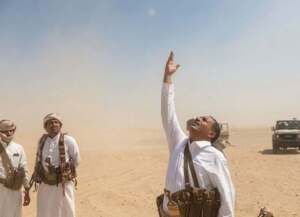
In response, the Houthi group has deployed military reinforcements to areas surrounding the tribal gathering while tightening security measures throughout territories under its control. Reports have also indicated that the group has disrupted telecommunications and internet services in several areas, a move widely interpreted by observers as an attempt to isolate the unfolding events from media coverage and restrict the flow of information.
Meanwhile, intermittent armed confrontations have been reported in the districts of Bart Al-Anan and Al-Zahir between tribal fighters and Houthi militants, further escalating tensions and fueling speculation about the possibility of wider armed clashes.
Origins of the Dispute
The dispute stems from a property ownership conflict in Sana'a involving a woman identified as "Mira," who claims to belong to the family of former Iraqi President Saddam Hussein, and prominent Houthi-affiliated figure Fares Manaa, who allegedly seized the property with the backing of the Houthi militia.
According to Sheikh Hamad bin Fadgham Al-Hazmi, the woman sought his protection and mediation under Yemen's long-established tribal customs. Instead, both were reportedly abducted by Houthi forces. The sheikh remained in detention for nearly fifty days before eventually escaping Houthi-controlled territory and reaching government-controlled areas east of Al-Jawf.
Sheikh Al-Hazmi says he was subjected to torture and intense pressure during his detention in an attempt to force him to sign concessions and record video statements contradicting the woman's account. Following his release, he performed the symbolic act known in Yemeni tribal tradition as "breaking the jambiya"—a ceremonial declaration of a general tribal Nakaf calling on tribes to mobilize in defense of honor and justice. He described the treatment of the woman who had sought his protection as a "Black Shame" (Aib Aswad)—one of the gravest violations of tribal honor under Yemeni customary law.
Why Did the Tribes Respond So Quickly?
Observers believe the scale of the response cannot be explained solely by the immediate dispute. Rather, it reflects years of accumulated resentment within Yemen's tribal communities toward Houthi governance.
Among the primary drivers of this growing anger are the group's escalating abuses against tribal communities, what critics describe as deliberate policies of humiliation, systematic economic deprivation, continued sectarian indoctrination, arbitrary measures, repeated allegations of land and property confiscation, and the imposition of heavy taxes and extortion under various pretexts. These grievances have been compounded by the prolonged economic crisis and the suspension of public-sector salaries in Houthi-controlled areas, further widening the gap between the group and Yemen's tribal society.